SongGPT
SongGPT
SongGPT
SongGPT
DELIVERABLES
UI DESIGN / BRANDING
INDUSTRY
DIGITAL WELLNESS
DURATION
2 MONTHS
PLATFORM
WEB
DELIVERABLES
UI/UX DESIGN / BRANDING
INDUSTRY
AI Music Technology
DURATION
2 MONTHS
PLATFORM
Web / Mobile
We designed an AI music platform from zero. 338,000 users and $500 in first revenue later, here's how we did it.
We designed an AI music platform from zero. 338,000 users and $500 in first revenue later, here's how we did it.
We designed an AI music platform from zero. 338,000 users and $500 in first revenue later, here's how we did it.
THE SITUATION
THE SITUATION
THE SITUATION
SongGPT is not a client project. It is a product of Persist Ventures, our parent company. We designed, built, and launched from the ground up for Persist Ventures, which means every design decision, every product choice, and every outcome belongs entirely to the team that made it.
Users often fall into “doomscrolling” endless passive consumption of content that offers little meaning or growth.
The brief was self-imposed and unambiguous: build an AI music creation platform that makes the process of going from idea to published song feel genuinely seamless for people who have never composed a note in their life.
Users often fall into “doomscrolling” endless passive consumption of content that offers little meaning or growth.
No existing product to reference. No founder handing over a vision document. Just a product opportunity in a fast-moving space, and the discipline to execute on it before the window closed.
Development started in September. The product was live in December. Revenue began in February.
Users often fall into “doomscrolling” endless passive consumption of content that offers little meaning or growth.
The typical social feed is driven by engagement metrics rather than what’s actually healthy or fulfilling.
There is a need for an alternative experience: one that encourages reflection, learning, and intention rather than distraction.
THE PROBLEM
THE PROBLEM
THE PROBLEM
AI music generation had arrived, but the experience of using most platforms told a different story to the technology underneath them.
The existing tools approached music creation as a technical process. You entered parameters. You selected a genre. You waited. You received a file. There was no sense of journey, no discovery layer, no reason to come back after your first generation. The act of creating a song felt like operating a converter rather than making something.
Users often fall into “doomscrolling” endless passive consumption of content that offers little meaning or growth.
The deeper problem was separation. Lyric generation lived in one place. Audio production in another. Sharing and discovery in a third. A user who wanted to go from an idea in their head to a finished, shareable track would need to stitch together multiple tools, multiple exports, multiple steps, each one adding friction to a process that should feel electric.
Users often fall into “doomscrolling” endless passive consumption of content that offers little meaning or growth.
And underneath all of this was a social problem nobody had solved: AI-generated music had no natural home. No community. No way to discover what others were making, to be inspired by it, to build on it. The creation was isolated. The experience ended when the file downloaded.
SongGPT was built to solve all three problems at once, not as separate features bolted together, but as a single coherent experience.
Users often fall into “doomscrolling” endless passive consumption of content that offers little meaning or growth.
The typical social feed is driven by engagement metrics rather than what’s actually healthy or fulfilling.
There is a need for an alternative experience: one that encourages reflection, learning, and intention rather than distraction.


THE APPROACH
THE APPROACH
THE APPROACH
The hardest design decision: making generation feel like creation.
The hardest design decision: making generation feel like creation.
The hardest design decision: making generation feel like creation.
The central challenge of SongGPT's UX was one that no amount of good visual design alone could solve: how do you make an AI music tool feel engaging rather than mechanical?
Users often fall into “doomscrolling” endless passive consumption of content that offers little meaning or growth.
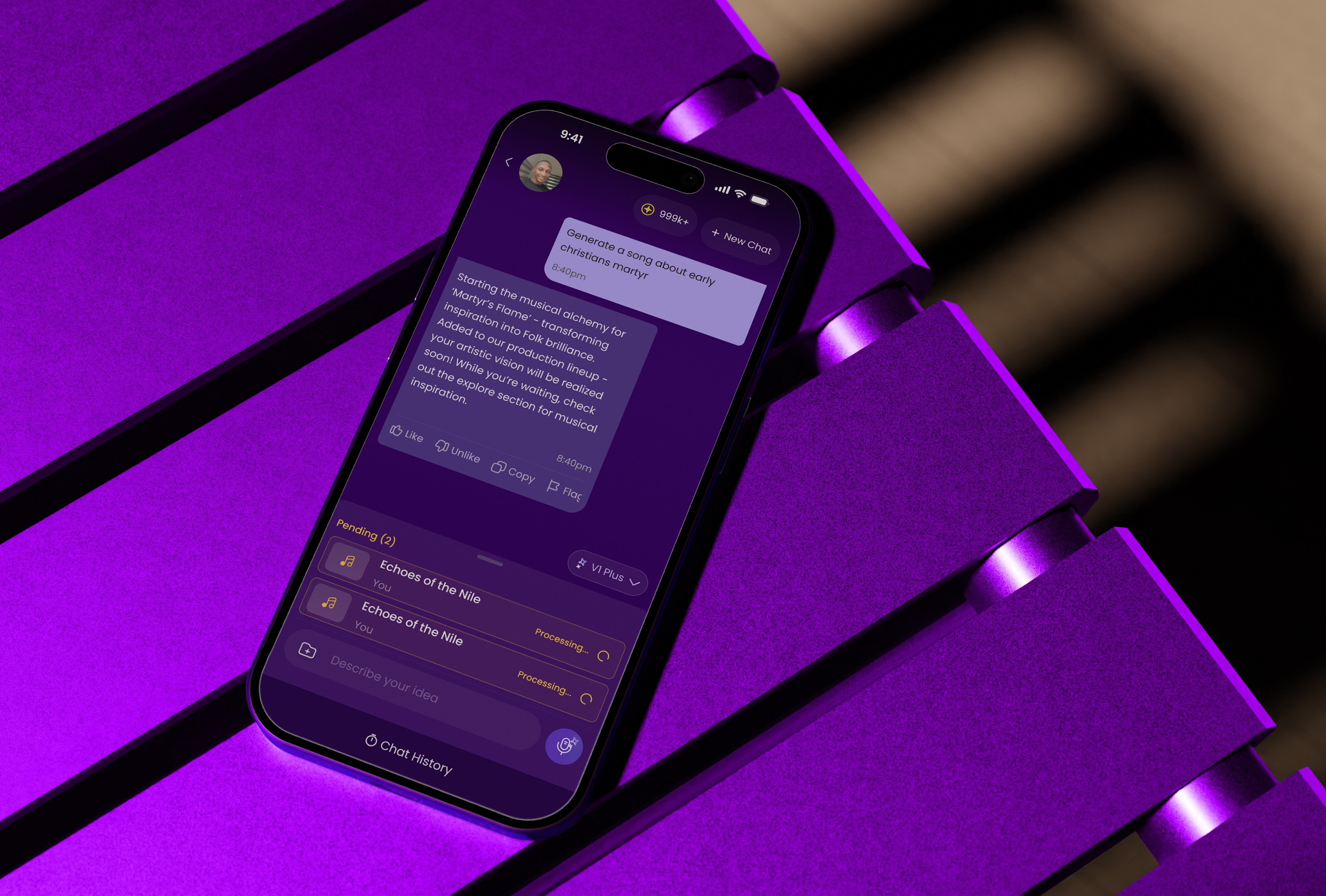
The answer came from rethinking the generation interface entirely. Instead of a form, genre dropdowns, tempo sliders, and keyword fields, we designed the Create section as a chat interface. The user describes what they want in natural language. The AI responds, refines, and generates. The interaction feels like collaborating with a producer, not configuring a machine.
Users often fall into “doomscrolling” endless passive consumption of content that offers little meaning or growth.
This was the hardest decision because it was the most non-obvious one. A form would have been faster to design and simpler to explain. The chat model required more design thinking, more iteration, and more trust in the user's ability to express themselves without structure. It was the right call. The generation experience is one of the most commented-on elements of the platform.
Users often fall into “doomscrolling” endless passive consumption of content that offers little meaning or growth.
The typical social feed is driven by engagement metrics rather than what’s actually healthy or fulfilling.
There is a need for an alternative experience: one that encourages reflection, learning, and intention rather than distraction.
The typical social feed is driven by engagement metrics rather than what’s actually healthy or fulfilling.
There is a need for an alternative experience: one that encourages reflection, learning, and intention rather than distraction.
Building the navigation around three distinct modes.
Building the navigation around three distinct modes.
Building the navigation around three distinct modes.
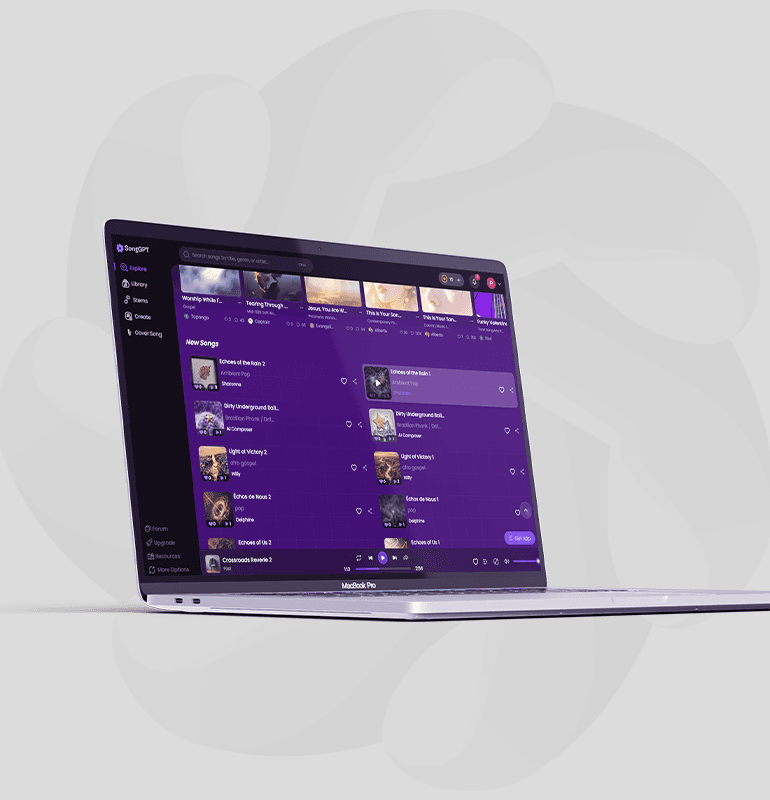
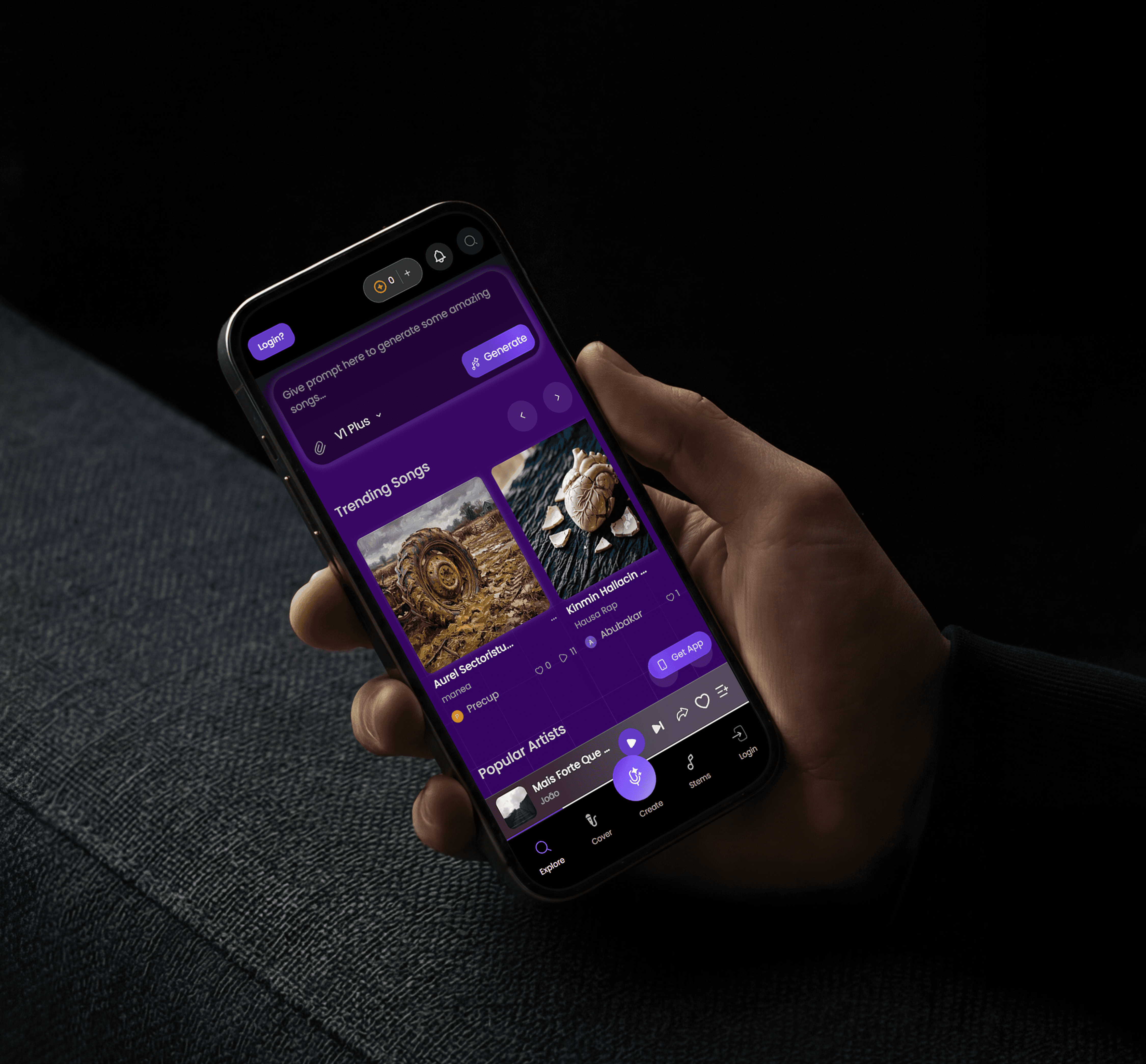
The sidebar navigation, Explore, Create, Stems, represents three genuinely different relationships with music, and each section was designed to reflect that.
Users often fall into “doomscrolling” endless passive consumption of content that offers little meaning or growth.
Explore is the discovery and community layer. Public songs and playlists, browsable and listenable without creating anything. This is where a new user lands and immediately understands that SongGPT is not just a tool, it's a platform where things are being made and shared constantly. Discoverability was designed in from day one: not as an afterthought feature, but as the front door.
Users often fall into “doomscrolling” endless passive consumption of content that offers little meaning or growth.
Create is the generation engine, the chat interface where songs are born. The experience is deliberately uncluttered. The focus is entirely on the conversation and the output. Credits are shown clearly, the generation state is communicated without anxiety, and the path from prompt to playable track is as short as possible.
Users often fall into “doomscrolling” endless passive consumption of content that offers little meaning or growth.
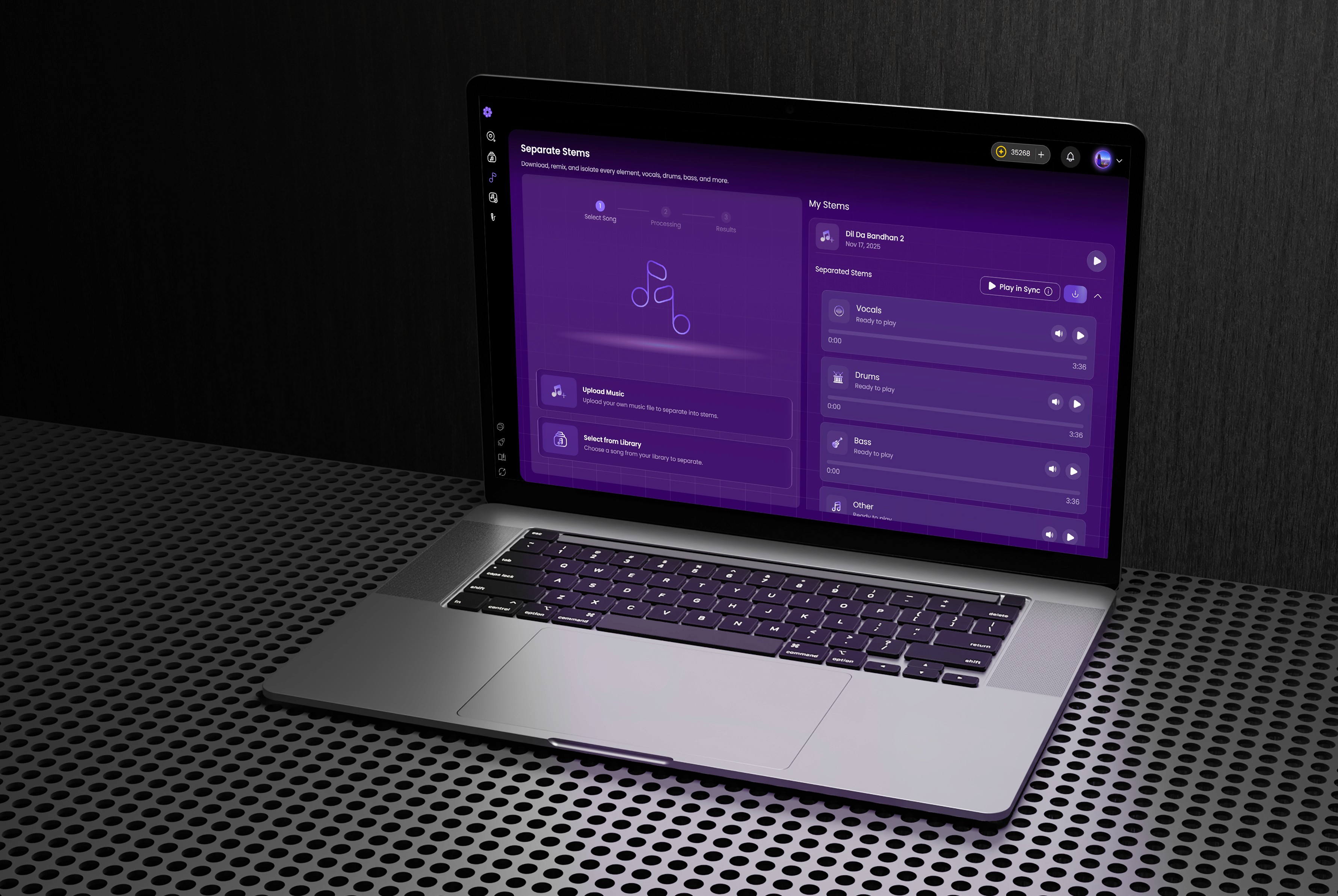
Stems is for the more serious user, access to individual vocal and instrumental tracks for remixing and deeper editing. This section serves a different audience than the casual creator, and was designed with enough separation that it doesn't complicate the entry experience while remaining immediately accessible to those who need it.
Users often fall into “doomscrolling” endless passive consumption of content that offers little meaning or growth.
The typical social feed is driven by engagement metrics rather than what’s actually healthy or fulfilling.
There is a need for an alternative experience: one that encourages reflection, learning, and intention rather than distraction.
The credit and referral system: keeping engagement honest.
The credit and referral system: keeping engagement honest.
The credit and referral system: keeping engagement honest.
One of the more considered structural decisions in SongGPT was how to handle the credit economy. Generation consumes credits. Credits can be purchased or earned, including through referrals, where both the referrer and the new user receive 30 free credits when a friend signs up.
Users often fall into “doomscrolling” endless passive consumption of content that offers little meaning or growth.
This wasn't designed as a growth hack. It was designed as a natural mechanic: if you made something you want your friend to hear, the easiest way to share it also earns you both more creative room. The sharing behaviour and the acquisition behaviour are the same behaviour. That alignment between what users want to do and what the product needs them to do is a design decision as much as a business one.
Users often fall into “doomscrolling” endless passive consumption of content that offers little meaning or growth.
The typical social feed is driven by engagement metrics rather than what’s actually healthy or fulfilling.
There is a need for an alternative experience: one that encourages reflection, learning, and intention rather than distraction.
Playlist creation and the AI Cover Generator.
Playlist creation and the AI Cover Generator.
Playlist creation and the AI Cover Generator.
Playlist creation with custom cover images and optional AI-generated artwork extended the platform from single-song creation into a collection-building experience. A user who creates enough songs to curate a playlist is a user who is invested in the platform. The AI Cover Generator, a separate feature that generates visual artwork to accompany tracks, added a layer of completeness to the creation experience: you don't just make a song, you make something you'd want to put on a shelf.
Users often fall into “doomscrolling” endless passive consumption of content that offers little meaning or growth.
The typical social feed is driven by engagement metrics rather than what’s actually healthy or fulfilling.
There is a need for an alternative experience: one that encourages reflection, learning, and intention rather than distraction.
Design input was collaborative.
Design input was collaborative.
Design input was collaborative.
The UX was built with design contributions from across the team, including input from Ansh and Kelvin throughout the process. The final product reflects that collaboration: a design that was stress-tested against multiple perspectives before it reached users.
Users often fall into “doomscrolling” endless passive consumption of content that offers little meaning or growth.
The typical social feed is driven by engagement metrics rather than what’s actually healthy or fulfilling.
There is a need for an alternative experience: one that encourages reflection, learning, and intention rather than distraction.
THE OUTCOME
THE OUTCOME
September
development begins
December
SongGPT goes live
February
first revenue generated
2 months post-launch
5,000 users and $500–600 in revenue, the first milestone hit
September
development begins
December
SongGPT goes live
February
first revenue generated
2 months post-launch
5,000 users and $500–600 in revenue, the first milestone hit
September
development begins
December
SongGPT goes live
February
first revenue generated
2 months post-launch
5,000 users and $500–600 in revenue, the first milestone hit
September
development begins
December
SongGPT goes live
February
first revenue generated
2 months post-launch
5,000 users and $500–600 in revenue, the first milestone hit
Today
Today
downloads on Google Play
215,970+
215,970+
Downloads on the App Store
4,970+
4,970+
Total users on the platform
337,970+
337,970+
downloads on Google Play
215,970+
215,970+
Downloads on the App Store
4,970+
4,970+
Total users on the platform
337,970+
337,970+
downloads on Google Play
215,970+
215,970+
Downloads on the App Store
4,970+
4,970+
Total users on the platform
337,970+
337,970+
These are not numbers from a well-funded marketing campaign. They are the result of a product that works well enough that people find it, use it, and tell others about it. The referral system generates organic growth. The Explore layer keeps users coming back. The creation experience keeps them creating.
Users often fall into “doomscrolling” endless passive consumption of content that offers little meaning or growth.
These are not numbers from a well-funded marketing campaign. They are the result of a product that works well enough that people find it, use it, and tell others about it. The referral system generates organic growth. The Explore layer keeps users coming back. The creation experience keeps them creating.
SongGPT is one of the clearest demonstrations of what Persist is built to do: take an idea from zero to a live product with real users and real revenue, on a timeline that most teams would consider impossible.
Users often fall into “doomscrolling” endless passive consumption of content that offers little meaning or growth.
SongGPT is one of the clearest demonstrations of what Persist is built to do: take an idea from zero to a live product with real users and real revenue, on a timeline that most teams would consider impossible.
The typical social feed is driven by engagement metrics rather than what’s actually healthy or fulfilling.
There is a need for an alternative experience: one that encourages reflection, learning, and intention rather than distraction.
Other Projects
Other Projects
Ready
to take
the next
s
t
p
?

Akash MishRA
Co-founder, Persist Designs
Just send me your product link. I'll show you what we'd
change and you can decide from there. No long pitch about us.
Ready
to take
the next
s
t
p
?
Akash MishRA
Co-founder, Persist Designs
Just send me your product link. I'll show you what we'd
change and you can decide from there. No long pitch about us.
Ready
to take
the next
s
t
p
?
Akash MishRA
Co-founder, Persist Designs
Just send me your product link. I'll show you what we'd change and you can decide from there. No long pitch about us.
© copyright 2026 - Persist Designs. All rights reserved
Ready
to take
the next
s
t
p
?
Akash MishRA
Co-founder, Persist Designs
Just send me your product link. I'll show you what we'd
change and you can decide from there. No long pitch about us.